
The first months of 2026 have brought serious challenges for drivers, business owners, and the entire logistics sector. Soaring fuel costs driven by geopolitical tensions in the Middle East have rippled across almost every sector of the economy. The vending machine industry is no exception, as the day-to-day operation of vending machine networks depends directly on diesel availability and price.
What’s happening with fuel prices?
The situation escalated rapidly in early 2026. The Irish government introduced maximum fuel price regulations starting 31 March 2026, in direct response to the energy crisis triggered by the US-Israel conflict with Iran. Before these controls came into effect, the picture was alarming. On some forecourts, petrol prices were approaching €2 per litre equivalent, while diesel was climbing even higher.
The pressure has been felt equally sharply across the Europe. In France, hauliers and farmers took to the roads in protest, with diesel prices reaching levels that threatened the viability of food production across the continent.
Closer to home, the average price of diesel in Ireland as of 8 April 2026 stood at approximately €1.85 per litre significantly higher than in neighbouring Britain, and considerably more than in countries where VAT reductions have provided relief at the pump.
What does this mean for vending machine operators?
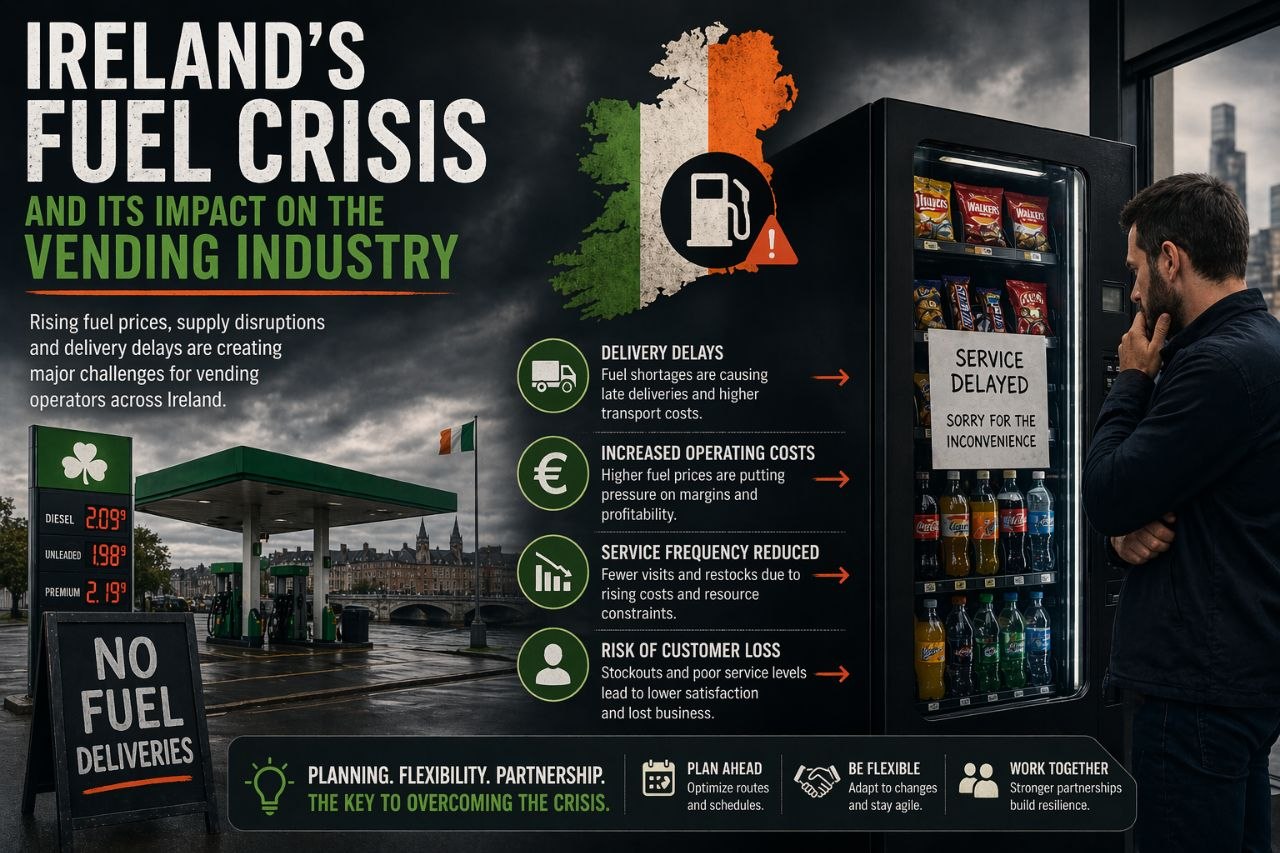
For anyone running a vending machine business, fuel is not just a line item on an invoice it’s the backbone of your entire supply chain. Every restocking run, every maintenance visit, every product delivery is affected when diesel prices spike. Higher fuel costs mean:
- More expensive restocking routes — the cost of driving between locations compounds quickly across a large vending machine estate
- Pressure on product margins — when delivery costs rise, either prices go up or profit shrinks
- Longer service intervals — some operators are consolidating routes and reducing visit frequency to manage costs, which can lead to stockouts
How is the industry adapting?
Smart vending machine operators are responding by doubling down on efficiency. Route optimisation tools, better remote monitoring of stock levels, and consolidating deliveries are all strategies gaining traction right now. Machines equipped with telemetry which report stock levels in real time allow operators to avoid unnecessary journeys and only dispatch when genuinely needed.
This crisis is also accelerating a longer-term shift: the argument for cashless, connected vending machine solutions that reduce wasted trips has never been stronger.
The bigger picture
The Irish and broader European fuel situation reflects a pattern seen across the last three years — energy prices are deeply vulnerable to geopolitical events, and the current instability shows no signs of a quick resolution.For businesses like vending machine operators that rely on regular, predictable logistics costs, building in contingency planning is no longer optional.
At Vending4you, we’re watching these developments closely and working to keep our service reliable and cost-effective for our clients, regardless of what the fuel market throws at us.